
Florida State University is my alma mater. I earned two degrees there, remain a devoted Seminoles fan, and have a vested interest in the success of its athletics programs.
That disclosure matters because I’m about to examine a consequential decision facing the university through a different lens: organizational architecture.
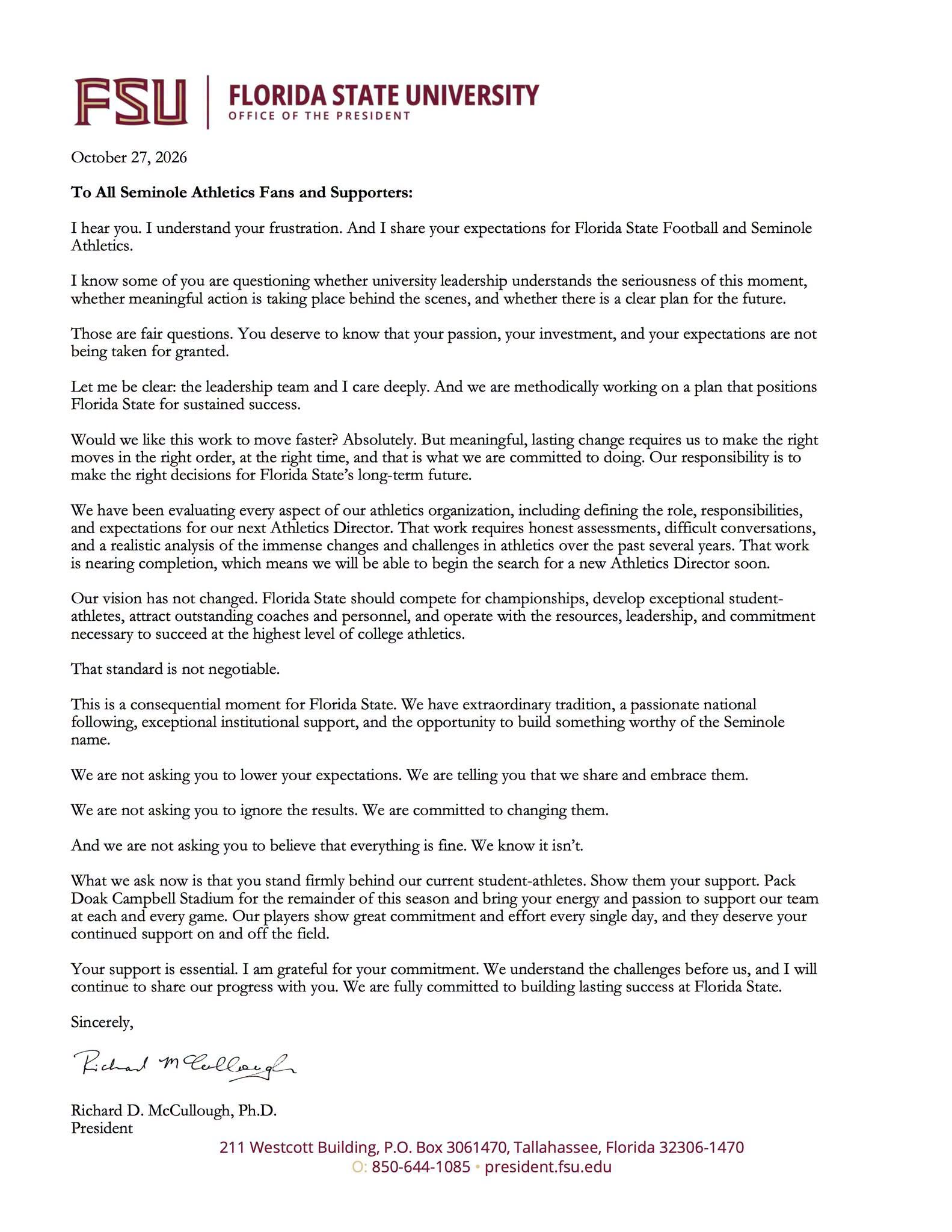
Earlier today, FSU President Richard McCullough issued a letter to Seminole athletics supporters addressing the university’s ongoing leadership transition.
One passage particularly caught my attention:
The university has been evaluating its athletics organization, including defining the role, responsibilities, and expectations of its next Athletics Director, before beginning the search.
From an organizational architecture perspective, that sequence makes sense.
Too often, organizations recruit leaders to solve problems without first examining the structures, systems, authority, information, and processes within which those leaders will be expected to operate.
They hire a person to fix what may be an architectural problem.
But there’s an important distinction between designing an executive role and making the executive’s decisions in advance.
Governance establishes expectations and accountability. Architecture establishes the conditions for execution. Leadership operates within that architecture.
For a university athletics program, that raises several questions worth considering:
- What decisions should remain with the president and governing board?
- What authority should be delegated to the Athletics Director?
- What resources, systems, and reporting relationships will support that authority?
- How will the institution distinguish accountability for results from interference in the decisions required to produce them?
These aren’t questions unique to college athletics. They’re relevant whenever an organization hires an executive, restructures a department, or attempts to correct persistent performance problems.
I want to be explicit about something: This is not a preemptive criticism of Florida State’s leadership, its approach, or its decisions to date.
The public letter describes an evaluation process. It doesn’t reveal the details of that process, the conclusions being reached, or the decision rights that will ultimately be established. It would be irresponsible to pretend otherwise.
Indeed, the fact that the university is examining the organization before recruiting its next leader is potentially encouraging.
The architectural test will come later.
Will the next Athletics Director inherit a clearly defined mandate, appropriate authority, functioning systems, and accountability commensurate with the position’s responsibilities?
Or will the institution expect executive-level results while retaining operational decisions elsewhere?
That’s the distinction worth watching.
And it applies just as much to a 15-person nonprofit or a growing business as it does to a major university.
Before asking whether you’ve hired the right leader, ask whether you’ve designed an organization that allows the right leader to succeed.
About the Operational Organization Framework
The Operational Organization Framework (OOF), developed by RBI Consulting Group, provides a systematic approach to diagnosing, designing, implementing, and sustaining effective organizational operations.
At its core is a simple principle: organizational performance is shaped not only by the people doing the work, but by the structures, systems, authority, information, and processes within which that work occurs.
The framework helps leaders examine whether their organization’s architecture supports the outcomes they expect, and where deliberate changes may be necessary.
Learn more about the Operational Organization Framework at rbiconsultinggroup.com/the-framework.
Leave a Reply